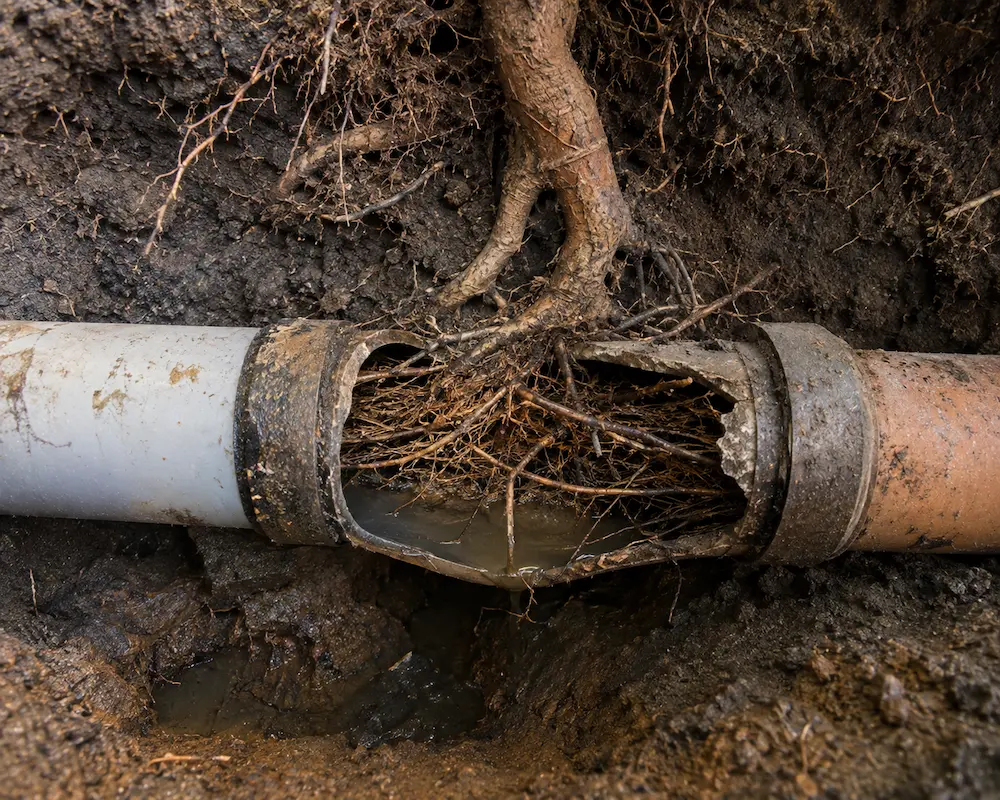
Tree roots are one of the most persistent and destructive threats facing modern residential plumbing systems. Beneath the surface, trees naturally expand their root networks to seek out essential moisture, oxygen, and nutrients. Because underground main sewer lines carry a continuous flow of warm, nutrient-rich wastewater, even tiny hairline cracks or loose pipe joints act as an irresistible beacon for root systems. Over time, microscopic root tips enter the pipe interior, expanding into dense, web-like masses that trap debris, crush structural piping, and trigger severe sewage backups inside your home.
Why Tree Roots Seek Out Underground Sewer Lines
Trees require significant volumes of water daily to survive, often extending their root systems up to two or three times the total width of their branch canopy. Older sewer lines, especially those constructed from clay tile, cast iron, or orangeburg pipe, feature numerous mechanical joints and porous seams every few feet.
| Pipe Material | Vulnerability Level | Primary Mechanical Weakness | Root Entry Risk |
| Clay Tile | High | Mortar joints deteriorate and crack | Extreme (Roots penetrate clay seams effortlessly) |
| Cast Iron | Moderate | Bottom channel rust and seam flaking | High (Corrosion creates easy entry gaps) |
| PVC / Plastic | Low | Joint glue failure or ground shifting | Low (Smooth walls deter grip unless cracked) |
| HDPE Continuous | Minimal | Seamless fused pipe construction | Minimal (No joints available for roots to penetrate) |
As warm water vapor escapes through microscopic joint fractures into surrounding subsoil, tree roots follow the moisture gradient directly toward the source. Once inside the pipe, the rich nutrient environment accelerates growth, causing root bundles to multiply rapidly inside the main line.
Telltale Signs of Tree Roots in Your Sewer Line
Detecting root infiltration during its early stages protects your plumbing infrastructure from total line collapse and avoids costly structural restoration. Homeowners should stay alert for several unmistakable warning signs across their indoor fixtures and outdoor yard.
1. Frequent and Recurring Main Line Clogs
When multiple fixtures across your home, such as ground-floor toilets, bathtub drains, and kitchen sinks, back up simultaneously, the obstruction resides deep within your main sewer lateral rather than individual branch lines. When standard plunging or chemical drain products yield no lasting relief, thick root masses are typically catching solid waste underground.
2. Gurgling Toilet Bowls and Slow Drains
Air trapped behind an underground sewage blockage must find an exit path. As wastewater struggles to flow past a root-choked section of pipe, it forces displaced air backward through your plumbing vents, producing distinct gurgling sounds from toilet bowls and floor drains whenever water empties elsewhere in the house.
3. Unusually Green, Lush Patches of Lawn
A leaking underground sewer line acts as an automatic, concentrated liquid fertilizer for your yard. If you notice a specific strip of grass that appears significantly greener, taller, or more lush than the rest of the lawn, particularly along the underground path between your home foundation and the municipal street connection, it frequently indicates an active underground sewage leak caused by root damage.
4. Foul Sewage Odors and Yard Sinkholes
When tree root pressure fractures a pipe completely, wastewater saturates the surrounding soil profile. This leads to persistent sewer gas smells escaping near your lawn and, in advanced cases, creates small depressions or soggy sinkholes above the damaged sewer lateral.
For comprehensive assistance with main line drain clearing and structural piping repairs, explore our complete residential plumbing and drain services.
Serious Risks of Neglecting Root Intrusion
Allowing tree roots to remain inside your main sewer line leads to far more than temporary drainage inconveniences.
Complete Sewer Main Structural Collapse
Expanding root masses function like heavy hydraulic wedges. As individual roots grow thicker inside the pipe cavity, they exert tremendous outward pressure against pipe walls, shattering clay or cast iron segments and collapsing the structural line entirely.
Hazardous Interior Sewage Backups
A completely blocked main sewer line forces incoming household wastewater directly back up through your lowest indoor drains. Raw sewage backups present severe health hazards and cause thousands of dollars in structural drywall, flooring, and personal property damage.
Environmental Soil and Water Contamination
Fractured main lines leak untreated wastewater into local soil profiles. According to public health guidelines established by the U.S. Environmental Protection Agency (EPA), compromised private sewer lines contribute significantly to soil contamination and municipal sanitary sewer overflows.
To understand how modern non-invasive plumbing technology restores damaged underground pipes without destroying your landscape, review our practical guide on trenchless sewer line repair solutions.
Professional Step-by-Step Process for Eliminating Tree Roots
Permanently resolving a root-infested sewer line requires commercial-grade machinery and advanced plumbing techniques designed to clear obstructions and seal pipe walls against future intrusion.
Step 1: High-Definition HD Video Camera Inspection
Technicians feed a flexible fiber-optic camera down the sewer cleanout port to map exact root entry points, determine line depth, and assess total pipe condition.
Step 2: Mechanical Cutting & High-Pressure Hydro-Jetting
Rotating steel blades slice through dense root bundles while high-pressure water jets scour the inner pipe walls to flush all remaining debris out of the system.
Step 3: Chemical Foaming Root Inhibitor Application
Non-systemic foaming herbicides are applied inside the cleared pipe to deactivate remaining root tips and prevent rapid re-growth without harming the tree above.
Step 4: Structural Trenchless Pipe Lining (CIPP)
An epoxy-saturated resin liner is inverted into the damaged section, forming a smooth, seamless inner wall that permanently blocks future root access.
Rehabilitation standards published by the U.S. Department of Housing and Urban Development (HUD) confirm that trenchless pipe rehabilitation methods, such as cured-in-place pipe lining, offer long-term structural repairs that eliminate the need for costly trench excavation.
Protect your property from hazardous sewage backups, eliminate aggressive tree roots, and restore smooth main line drainage. Contact us today to schedule your high-definition sewer camera inspection and professional root clearing estimate!